
Autosana vs ACCELQ: Which one should you actually pick?
Compare Autosana and ACCELQ across agentic testing, test authoring, self-healing, platform coverage, MCP integration, pricing, real-device testing, and enterprise workflows to determine which testing approach best fits your team.
Yuvan Sundrani · 15 min read
autosana.ai
.png)
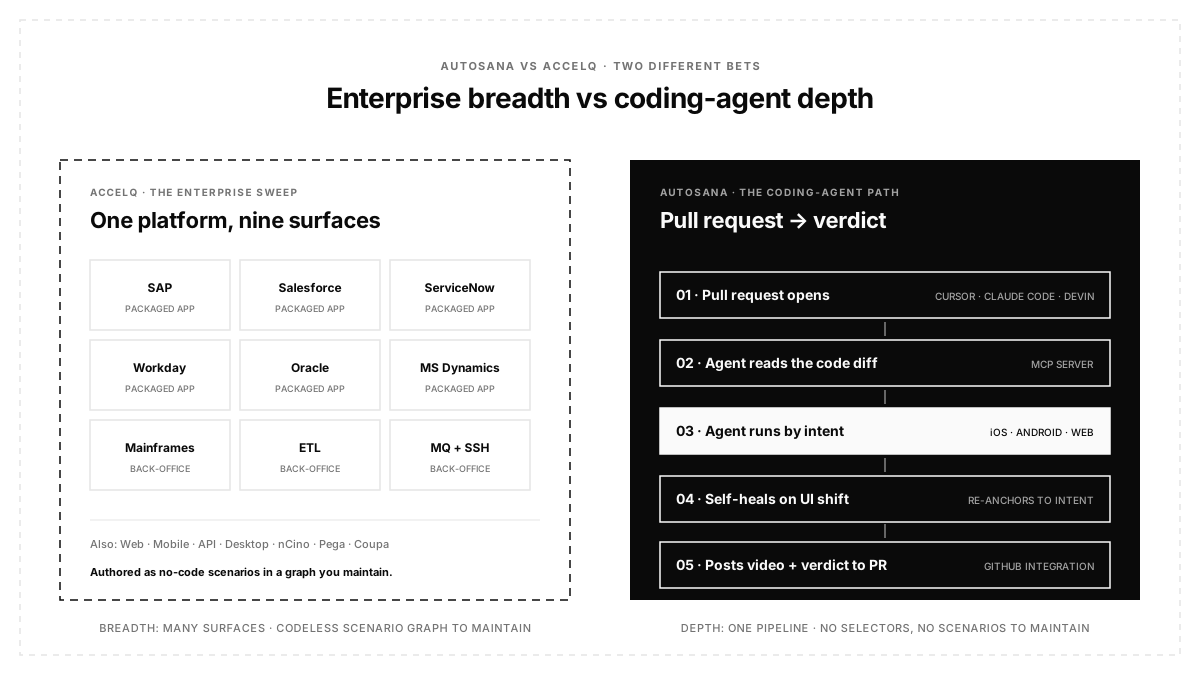
Autosana is an AI-native testing agent for iOS, Android, and web apps that runs your product by intent. No selectors written, no scenario paths maintained. ACCELQ is a codeless enterprise QA platform that unifies Web, Mobile, API, and Desktop automation with packaged app coverage (SAP, Salesforce, ServiceNow, Oracle, and more).
Key Takeaways
- ACCELQ is a codeless enterprise QA platform. Autosana is an AI agent that runs the flow by intent, without any scenario authoring or selector maintenance.
- ACCELQ prices contact-sales only, with a 10-license minimum for on-premise. Autosana prices per agent run, with a self-serve trial.
- Both ship self-healing, but the mechanism differs. ACCELQ patches locators inside its scenario graph. Autosana re-plans against the current UI on every run.
- ACCELQ's sweet spot is enterprise breadth (packaged apps, mainframes, ETL, SSH). Autosana's sweet spot is modern web plus mobile shipped weekly with coding agents in the loop.
- Autosana ships an MCP server that lets Cursor and Claude Code run the tests end-to-end against your PR without a test author touching selectors.
How do Autosana and ACCELQ compare at a glance?
| Axis | Autosana | ACCELQ |
|---|---|---|
| Category | AI-native testing agent | Codeless enterprise QA platform |
| Test Authoring | Natural language or code diff | Business Process Scenario Builder + no-code logic editor |
| Self-Healing | Re-plans against the current UI every run | Autonomous self-healing on scenario locators |
| Platform Coverage | iOS + Android + Web | Web + Mobile + API + Desktop + mainframes + packaged apps |
| Packaged-App Coverage | Not the target surface | SAP, Salesforce, ServiceNow, Workday, Oracle, MS Dynamics, Pega, Coupa, nCino |
| Coding-Agent MCP | MCP server → agent runs tests end-to-end | Not offered as of 2026 |
| Real-Device Layer | Hosted, included | ACCELQ Cloud Lab (contact-sales, Web + Mobile) |
| Pricing Model | Per agent-run (self-serve trial + paid) | Contact sales, 10-license minimum for on-premise |
| Setup to First Test | ~10 min (quickstart) | Trial + workspace provisioning |
What is ACCELQ?
ACCELQ is a codeless, AI-powered enterprise QA platform based in Dallas, Texas.
The platform bundles four automation products (Web, Mobile, API, and Manual) plus ACCELQ Live for packaged apps, all unified under the ACCELQ Unified plan. Its pitch is business-process-focused automation across the full enterprise stack.
Core capabilities per accelq.com: no-code logic editor, Business Process Scenario Builder, autonomous self-healing, in-sprint automation, cross-browser testing, and cloud or on-prem execution.
What is Autosana?
Autosana is a cloud-hosted AI agent that tests iOS, Android, and web apps the way a real user would. You describe a flow in natural language, or hand the agent a code diff. There are no selectors to author, no scenarios to build, no locators to maintain.
When the UI changes (a button label, a component refactor), the agent re-anchors to whatever now matches the intent. Runs across iOS and Android and web, with hosted device infrastructure and an MCP server for coding-agent workflows.
How do the two tools handle test authoring?
ACCELQ's core model is a Business Process Scenario Builder. You compose reusable scenarios visually, wire them together with a no-code logic editor, and layer test data on top. The goal is authoring by business analysts and QA leads without writing code, then handing execution to ACCELQ's runtime.
Autosana skips scenario authoring entirely. You describe the flow ("open cart, tap checkout, enter test card, confirm order") and the agent decides which element matches the intent at runtime. There is no scenario object to maintain.
The trade shows up in the shopping conversation. One r/servicenow reply captured the exploratory mindset teams bring to the ACCELQ pitch: "we do get adverts from time to time and wanted to get some opinions on whether it's worth looking into or not." The authoring model is usually the first thing that gets stress-tested in that evaluation.
How does the mobile story compare?
ACCELQ Automate Mobile is a no-code, cloud-based mobile automation product. Per accelq.com/pricing: native, hybrid, and web app automation, portable across iOS and Android, with real devices and simulators, plus support for third-party device farms or your in-house lab.
Autosana runs mobile as its default surface. iOS and Android are first-class, tests are authored as intents, and the hosted device layer is included in the trial.
If you already run a broad enterprise portfolio through ACCELQ and want mobile added into the same authoring surface, ACCELQ's mobile module slots in cleanly. If mobile is your primary product and you ship weekly, Autosana is built for that shape.
How does coding-agent (MCP) integration work in each?
Autosana ships an MCP server that lets Cursor, Claude Code, and Devin run tests end-to-end against your app. PR opens, agent picks up the code diff, runs the relevant flows across iOS, Android, and web, then posts a video plus verdict back via GitHub integration.
ACCELQ has not published an MCP server or coding-agent workflow on its 2026 site. Its automation runs through the ACCELQ Cloud Lab and CI pipelines the traditional way: schedule, run, report.
You can already see the direction of travel in community threads. One r/servicenow reply put the AI-native alternative plainly: "Just use ChatGPT to generate tests for you or purchase ServiceNow's test automation product." Teams are actively pricing generation-first tools against traditional scenario builders.
If your dev team already lives inside Cursor or Claude Code and PRs land faster than a human can author scenarios, the agent-in-the-loop path is the differentiator.
How does ACCELQ pricing actually work?
ACCELQ uses a contact-sales pricing model. Public plans are not listed on accelq.com/pricing. Buyers get pricing after a demo call.
Two structural notes from the page, verified live:
- On-premise deployment requires a minimum 10-license subscription.
- ACCELQ Cloud Lab (hosted execution environment for Web and Mobile) is quoted separately.
Cancellation is by email to support@accelq.com, and the account remains active through the current subscription period.
Autosana prices per agent-run rather than per seat, with a self-serve trial. The curve flattens as headcount grows because you're paying for runs, not editor seats. Book a Demo for a per-run quote against your PR volume.
How does maintenance scale as your suite grows?
ACCELQ's autonomous self-healing patches locators inside its scenario graph when the UI shifts. That handles a class rename or a minor DOM change cleanly. Structural refactors (a workflow re-sequenced, a new modal inserted, a scenario branch changing shape) still require a human to touch the scenario in the Business Process Scenario Builder.
Autosana's mechanism is different: the agent re-plans against the current UI each run. There is no stored scenario graph to touch when the flow reshapes. If the intent is still satisfiable ("tap Checkout after adding to cart"), the test passes.
Both are legitimate approaches. Coverage breadth is one reason teams stay on ACCELQ. One r/servicenow reply noted the pull: "ATF has a lot of limitations and Automate even works on third party tools." If your team ships weekly with coding agents writing PRs, the intent-based mechanism scales differently. Early customer stories including the Gobi Maps case study walk through what that looks like at Series A scale.

Which one should you actually pick?
Pick ACCELQ if:
- Your quality org spans the full enterprise stack: web, mobile, API, desktop, mainframes, ETL, plus packaged apps like SAP, Salesforce, ServiceNow, Oracle, or Workday.
- Business analysts and QA leads (not just engineers) are the primary authors.
- On-prem or private-cloud deployment is a compliance requirement, and 10+ licenses is a natural fit for your org size.
- You need pre-built packaged-app assets ready to run against Salesforce, Workday, or SAP without hand-writing each scenario.
Pick Autosana if:
- Your product is iOS, Android, or web (or a mix) shipped weekly or faster.
- Coding agents (Cursor, Claude Code, Devin) are opening PRs faster than a human can author scenarios, and you want the agent to run the tests end-to-end via MCP.
- You want the authoring, execution, and hosted device layers collapsed into one product with a self-serve trial.
- You value the features overview promise of intent-based tests that self-heal, over a codeless scenario graph you maintain.
The evaluation gets sharper when the surface is niche. One r/servicenow reply put it directly for a ServiceNow shop: "Try u/accelq it works better then ATF and AutomatePro." If your target surface is a packaged app like that, ACCELQ's coverage matters. If it's your own consumer or SaaS product, Autosana matters more.
Both are legitimate. Pick by which set of scenarios matches your team.
How do you migrate from ACCELQ to Autosana without regret?
If you decide the intent-based path fits, migrating a live ACCELQ suite is a project, not a swap. Here's the honest sequencing:
- Sort your ACCELQ scenarios into tiers. Tier A = critical business flows (login, checkout, payments, core user journeys). Tier B = regression. Tier C = long-tail edge cases. Many teams delete Tier C outright.
- Run Autosana in parallel with ACCELQ for one sprint. The Autosana quickstart walks through the parallel-run pattern. Compare flake rate, run time, and engineer-hours-per-week.
- Migrate Tier A first. Keep both suites live for one full release cycle.
- Migrate Tier B in the second wave. Delete Tier C or rebuild only what production traffic proves necessary.
- Keep ACCELQ for the enterprise surfaces it uniquely covers. SAP, Workday, and other packaged-app flows can stay on ACCELQ if that's your primary need there.
- Decommission the overlapping ACCELQ scope on a set date. Passive graveyards eat future engineer time.
The migration is easier than most teams expect for the UI-driven mobile and web scope. The parts that stay on ACCELQ (packaged apps, mainframes) are where its differentiation lives.
Conclusion
ACCELQ and Autosana are solving different problems.
ACCELQ is a codeless enterprise QA platform for organizations with broad packaged-app footprints. If SAP, Salesforce, ServiceNow, Workday, or mainframes sit inside your quality scope alongside web and mobile, and business analysts author scenarios, ACCELQ is a defensible pick.
Autosana is an AI-native testing agent for teams that want the authoring layer gone. Ship an iOS, Android, or web product weekly, use coding agents, and want authoring, execution, and hosted devices collapsed into one product? Autosana is the pick that removes the mechanism causing your maintenance cost, not just patches it inside a scenario graph.
Bring a build. We'll run it end-to-end across iOS, Android, and web in 30 minutes and you can compare directly against your current ACCELQ scope before making a call.
Frequently asked questions
Is ACCELQ free to try?
ACCELQ offers a free trial through its Try For Free links on the pricing page. There is no perpetually free tier. On-premise deployment requires a minimum 10-license subscription. Paid pricing is contact-sales only.
Which is better for mobile testing, Autosana or ACCELQ?
ACCELQ Automate Mobile runs native, hybrid, and web app automation across iOS and Android with real devices and simulators, priced separately. Autosana runs iOS and Android natively via its hosted device layer with agent-based flows, included in the trial. For teams that ship mobile weekly and want zero scenario maintenance, Autosana wins. For enterprise QA orgs running ACCELQ across a full stack and adding mobile as another surface, ACCELQ is defensible.
Does ACCELQ self-heal like Autosana?
Both self-heal, but via different mechanisms. ACCELQ's autonomous self-healing patches locators inside its scenario graph when the UI shifts. Autosana's agent re-plans against the current UI on every run: there is no stored scenario to patch. Different approach, different failure modes.
Can Autosana replace ACCELQ entirely?
For UI-driven E2E flows on iOS, Android, and web: yes. For packaged-app testing (SAP, Salesforce, ServiceNow, Workday, Oracle) plus mainframes, SSH, ESB, and MQ, ACCELQ covers surfaces Autosana doesn't target. Rule of thumb: if 60%+ of your ACCELQ scope is UI-driven web and mobile, Autosana replaces it. If most of the scope is packaged apps and back-office integrations, keep both.
How long does an ACCELQ-to-Autosana migration take?
For a mid-size scope (200 to 400 UI-driven flows), plan for one quarter end-to-end: two sprints of parallel-run evaluation, one sprint of Tier A migration, two sprints of Tier B, one sprint of decommissioning the overlapping ACCELQ scope. Keep ACCELQ for packaged-app scope where it's the differentiator.
Is ACCELQ on-prem an option?
Yes. Per the pricing page, on-premise deployment requires a minimum 10-license subscription. You host on your own servers and manage upgrades and operations. Cloud hosting is the default.