8 Best AccelQ Alternatives for Codeless Testing in 2026
Eight AccelQ alternatives organized by which part of the platform you need to replace: web/mobile E2E, packaged apps, codeless authoring, or full developer control.
YS
Yuvan Sundrani · 19 min read
autosana.ai
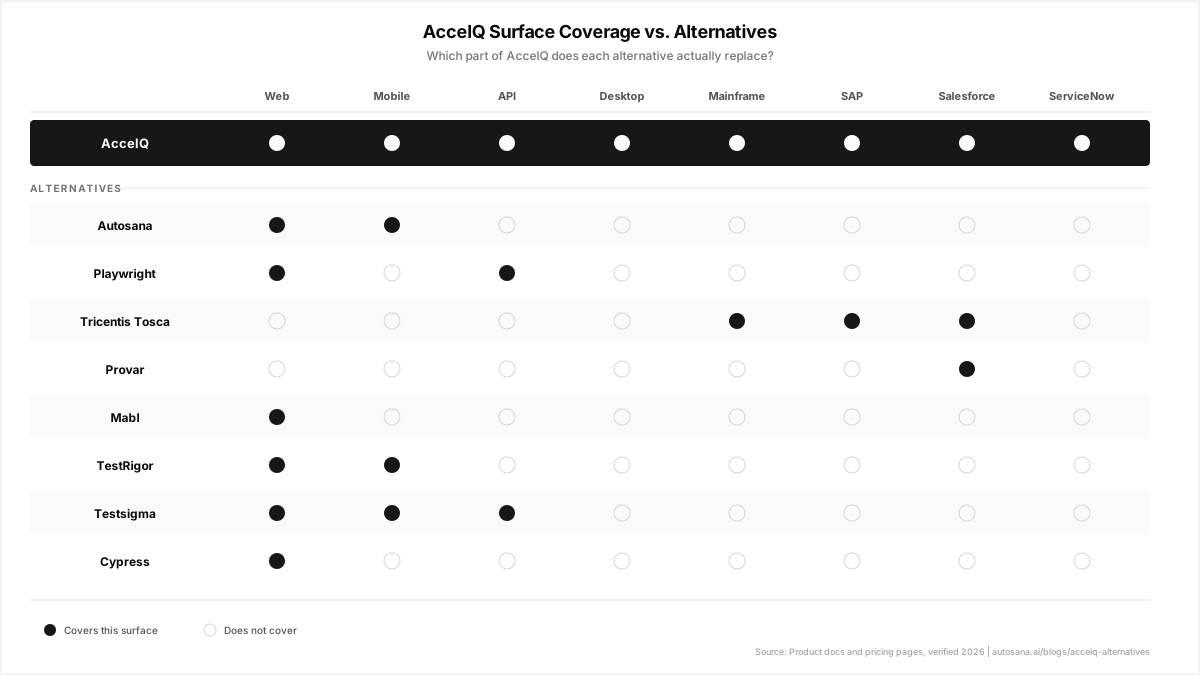
AccelQ covers an unusually broad surface: web, mobile, API, desktop, mainframes, SAP, Salesforce, ServiceNow, and more. Most alternatives only replace a slice of that. The eight alternatives below are organized by which part of AccelQ you actually need to replace: web and mobile E2E (Autosana, Playwright), packaged-app testing (Tricentis Tosca, Provar), codeless authoring with different architecture (Mabl, TestRigor, Testsigma), or full developer control (Cypress). Match the tool to the surface, not the category.
Key Takeaways
AccelQ's unique value is enterprise breadth (web + mobile + API + desktop + mainframe + SAP + Salesforce + ServiceNow). Most alternatives cover a subset, so the replacement depends on which surface matters most to your team.
For packaged-app testing (SAP, Salesforce, ServiceNow), Tricentis Tosca and Provar are the closest replacements. No other tool on this list matches that enterprise coverage.
Playwright and Cypress replace AccelQ's web testing surface with full developer control and zero licensing cost, but both are code-first and selector-based.
Codeless alternatives (Mabl, TestRigor, Testsigma) compete on AccelQ's authoring model but none match its breadth across enterprise surfaces.
Autosana replaces AccelQ's web and mobile surface with an AI agent that navigates by intent (no element model), ships an MCP server for coding-agent workflows, and posts session replay to every PR.
How do the 8 AccelQ alternatives compare at a glance?
Tool
Category
Replaces Which AccelQ Surface
Authoring
Free?
Autosana
AI-native agent
Web + Mobile E2E
Natural language
Trial + paid
Playwright
Code-first framework
Web + API
JS, TS, Python, Java, C#
Yes
Tricentis Tosca
Enterprise model-based
SAP + Salesforce + Mainframe
Model-based
Paid
Provar
Salesforce specialist
Salesforce
Low-code + Apex
Paid
Mabl
Cloud-native codeless
Web E2E
Visual builder
Paid
TestRigor
Plain-English codeless
Web + Mobile
Plain English
Paid
Testsigma
Open-source codeless
Web + Mobile + API
NLP + code
Yes (OSS) + paid
Cypress
Code-first (JS)
Web E2E (frontend DX)
JS / TS
Yes + paid cloud
Why are teams looking for AccelQ alternatives in 2026?
AccelQ is a legitimate enterprise platform. It rates 4.8/5 on G2 across 50+ reviews, offers a free trial, and covers more automation surfaces than any single alternative on this list. Teams leave for specific, structural reasons.
The pricing model filters out smaller teams. AccelQ uses contact-sales pricing with no public price points. On-premise deployment requires a minimum 10-license subscription. ACCELQ Cloud Lab (hosted execution for web and mobile) is quoted separately on top of the base license. A team evaluating the platform on r/servicenow captured the typical buyer posture: "we get adverts from ACCELQ and wanted opinions on whether it's worth looking into."
The codeless model carries lock-in risk. AccelQ's Business Process Scenario Builder and no-code logic editor are powerful for stable enterprise UIs. But when teams try to extend the platform beyond its sweet spot (dynamic SPAs, shadow DOM, fast-iterating mobile frontends), the abstraction becomes the constraint. A developer on r/programming noted the broader concern with these platforms: "the risk of vendor lock-in with low-code platforms limits flexibility long-term."
Mobile is not the primary strength. AccelQ Automate Mobile supports native, hybrid, and web app automation across iOS and Android with real devices and simulators. But teams shipping mobile as their core product weekly find the mobile surface thinner than web, and ACCELQ Cloud Lab is quoted separately rather than included.
No coding-agent or GitHub PR integration. AccelQ has not published an MCP server or GitHub PR integration as of 2026. Teams using Cursor, Claude Code, or Devin to generate PRs have no way to wire AccelQ into that loop automatically. The test-authoring bottleneck stays human-gated.
What are the best alternatives for AccelQ's web and mobile E2E testing?
If your AccelQ scope is primarily web and mobile UI flows (not packaged apps, mainframes, or back-office integrations), these two tools replace the testing surface directly.
1. Autosana
Best for: teams whose AccelQ pain is the codeless model breaking on modern SPAs, and who want the element-model layer eliminated entirely.
Autosana is a cloud-hosted AI agent that tests web, iOS, and Android apps the way a real user would. You describe a flow in natural language ("open cart, tap checkout, confirm order"), and the agent navigates by intent on real devices. There is no element model to maintain, no scenario graph to update, no locator to heal. When the UI changes (a button moves, a component refactors, a new modal appears), the agent re-anchors to whatever matches the intent on the current screen.
Where AccelQ models elements and heals locators heuristically inside a scenario graph, Autosana never creates locators in the first place. That is the structural difference, not a feature checkbox.
Key features:
Natural-language test authoring, no codeless abstraction to maintain
MCP server for Cursor, Claude Code, and Devin integration
Pricing: per agent-run, not per seat. Book a Demo for a quote.
Pick Autosana if your AccelQ scope is web and mobile UI flows shipped weekly, especially with coding agents in the loop. First run takes under ten minutes via the quickstart.
2. Playwright
Best for: developer teams that want full control, tests versioned in Git, and zero licensing cost.
Playwright is Microsoft's browser automation framework. It connects via the DevTools protocol instead of the older HTTP WebDriver protocol, ships auto-waiting for element actionability, and supports Chromium, Firefox, and WebKit under one API. For teams leaving AccelQ because they want tests in code rather than a visual scenario builder, Playwright is the most natural destination.
Key features:
Auto-waiting for actionable state (visible, stable, enabled)
Multi-browser (Chromium + Firefox + WebKit) under one API
Multi-language (JS/TS, Python, Java, C#)
Native API testing alongside browser testing
Codegen for recording interactions into runnable tests
Limitations: selector-based at the core. Auto-waiting solves timing, but not "the button was renamed and every test broke." No codeless mode. No native mobile (viewport emulation only). Requires developer skill to author and maintain.
Pick Playwright if your team has engineering depth and wants the most capable free framework for web testing.
What are the best alternatives for AccelQ's packaged-app testing?
ACCELQ LIVE is a purpose-built product for Salesforce, nCino, Workday, Oracle, ServiceNow, MS Dynamics, Pega, SAP, and Coupa. That breadth is AccelQ's genuine moat. A ServiceNow admin on r/servicenow noted the pull directly: "native test automation has limitations, and ACCELQ works on third-party tools too." If your team's primary AccelQ usage is packaged-app automation, these two tools cover that surface.
3. Tricentis Tosca
Best for: enterprise teams with SAP, Salesforce, and mainframe testing requirements who want a model-based platform architecturally similar to AccelQ.
Tricentis Tosca uses model-based test design, the closest architectural match to AccelQ's Business Process Scenario Builder. It covers SAP (native integration with SAP Solution Manager), Salesforce, mainframe terminals, and packaged applications. Tosca's risk-based test optimization narrows execution to the flows most affected by a code change, which helps at enterprise scale where running the full suite on every commit is impractical.
Key features:
Model-based test design, no scripting required
Deep SAP, Salesforce, and mainframe integrations
Risk-based test optimization for selective execution
Enterprise ALM integrations (Jira, Azure DevOps, SAP ALM)
Pricing: enterprise licensing (contact for pricing).
Limitations: heavy implementation and procurement cycle. Overkill for web-only or mobile-only teams. Not open source. Enterprise-priced.
Pick Tricentis Tosca if your AccelQ exit is about SAP or Salesforce depth, not about escaping the codeless model itself.
4. Provar
Best for: Salesforce-specialist teams that need deeper Salesforce automation than ACCELQ LIVE provides.
Provar is purpose-built for Salesforce. It understands Salesforce metadata natively (Lightning components, Visualforce pages, Salesforce APIs), which means test elements adapt automatically when Salesforce releases seasonal updates. Three major Salesforce releases per year break generic selectors. Provar's metadata awareness absorbs those updates without manual intervention. If ACCELQ LIVE covers Salesforce as one surface among many, Provar goes deeper on Salesforce as the only surface.
Key features:
Native Salesforce metadata integration
Auto-adapts to Salesforce seasonal releases
Low-code authoring with Apex scripting for power users
CI/CD integration with Salesforce DX pipelines
Pricing: paid (contact for pricing).
Limitations: Salesforce only. Not a general-purpose web or mobile testing tool. If your scope extends beyond Salesforce, Provar covers one surface and nothing else.
Pick Provar if Salesforce is your primary AccelQ surface and you need deeper Salesforce-native automation than a multi-surface platform offers.
What replaces AccelQ's codeless promise with a different codeless approach?
AccelQ's codeless pitch lands with QA teams that want automation without writing code. But codeless is a broad category with real internal trade-offs. A developer on r/developersIndia observed the pattern across these platforms: "low-code platforms don't scale well for complex applications." That scaling friction shows up in AccelQ and in every codeless alternative below. The question is which set of trade-offs you prefer.
5. Mabl
Best for: cloud-native QA teams wanting codeless testing without the enterprise IDE overhead AccelQ requires.
Mabl is a cloud-native testing platform with visual test creation, ML-based auto-healing, and built-in visual regression. Where AccelQ runs through a scenario builder you install and configure locally, Mabl runs entirely in the browser. The trade-off is clear: less enterprise breadth (no SAP, no mainframe, no packaged apps), more cloud-native simplicity for web-focused teams.
Key features:
Visual test builder with ML-based auto-healing
Cloud-native, no local installation or IDE
Built-in visual regression and accessibility testing
API testing alongside UI testing
Pricing: paid (contact for pricing).
Limitations: self-healing is heuristic-based (works for cosmetic shifts, not structural refactors). No open-source option. No packaged-app coverage. Less enterprise surface than AccelQ.
Pick Mabl if you want AccelQ's codeless promise in a lighter, cloud-native wrapper for web-focused testing.
6. TestRigor
Best for: organizations where business analysts (not QA engineers) need to write and maintain tests without any visual builder or IDE.
TestRigor takes the codeless concept further by accepting tests written as plain English statements. No element mapping, no visual recording, no model design. The platform interprets natural-language instructions and executes them against the app. For teams where AccelQ's Business Process Scenario Builder is still too technical for the intended authors, TestRigor lowers the authoring bar to written language.
Key features:
Plain-English test authoring (no abstraction layer)
Cross-browser and mobile testing
AI-driven element resolution at runtime
CI/CD and test management integrations
Pricing: paid (contact for pricing).
Limitations: less developer control than code-first tools. Debugging can be harder when the NLP interpretation misses the intended action. No open-source option.
Pick TestRigor if the people writing your tests are business stakeholders, not engineers, and they need to author without touching any builder or IDE.
7. Testsigma
Best for: teams that want codeless testing with the safety net of open source and self-hosting.
Testsigma offers NLP-based test authoring with a community edition you can self-host. It covers web, mobile, and API testing. If AccelQ's contact-sales pricing and vendor lock-in concern you, Testsigma gives you a codeless starting point with an escape hatch: you can fork the code, self-host the platform, and fall back to code-based scripting when the NLP layer hits its limits.
Key features:
NLP-based test authoring with code fallback
Open-source community edition (self-hostable)
Web, mobile, and API testing under one platform
Built-in test data management and parameterization
Pricing: free (community edition); paid cloud tier for enterprise features.
Limitations: smaller community than Playwright or Cypress. Enterprise features (advanced reporting, integrations) require paid tiers. Less enterprise packaged-app coverage than AccelQ.
Pick Testsigma if you want codeless authoring with open-source flexibility and no vendor lock-in on the core platform.
What replaces AccelQ when you want full developer control?
8. Cypress
Best for: JS/TS frontend teams that want time-travel debugging and tests living in the same repo as the application code.
Cypress runs inside the browser's own event loop, which unlocks its signature developer experience: DOM snapshots at every test step, real-time reloading during local development, and debugging that feels native to frontend engineers. For teams leaving AccelQ because the codeless abstraction layer got in the way of fast iteration, Cypress represents the opposite philosophy. Everything is code. Everything is in version control. The debugging experience is tuned for the frontend developer, not the QA analyst.
Key features:
Time-travel debugging with per-step DOM snapshots
Automatic waiting for DOM stability and network requests
Pricing: free (MIT) + Cypress Cloud paid tier for parallel execution and analytics.
Limitations: JS/TS only. Cannot automate cross-origin or cross-tab flows cleanly. No native mobile (viewport emulation only). Parallel execution requires paid Cypress Cloud. Single browser at a time during test runs.
Pick Cypress if you are 100% JS/TS, testing a single-origin app, and the time-travel debugging experience matters to your frontend engineers.
How do coding agents change the AccelQ replacement decision?
AccelQ was designed for a world where a human authors every test scenario inside a visual builder. In 2026, many teams run Cursor, Claude Code, or Devin to generate PRs faster than a QA team can build scenarios to cover them. A commenter on r/servicenow put the shift plainly: "just use AI to generate tests or buy the platform's native test automation product."
That instinct points toward tools with native coding-agent integration. AccelQ has not published an MCP server or coding-agent workflow as of 2026. Its automation runs through ACCELQ Cloud Lab and CI pipelines the traditional way: schedule, run, report.
Autosana ships an MCP server that lets Cursor and Claude Code invoke a test run end-to-end against a PR. The coding agent reads the diff, Autosana runs the relevant flows across web and mobile on real devices, and session replay posts back to the PR via GitHub integration. No human authors a scenario. No human triages a result. The agent loop closes automatically.
If your team already uses coding agents and the test-authoring bottleneck is the human in the loop, the MCP-native path matters more than whether the platform is codeless or code-first.
Which AccelQ alternative should you actually pick?
The right answer depends on which AccelQ surface you are actually replacing. A practitioner on r/QualityAssurance described the natural split: "answers split by use case: Playwright for web, Appium or vision-based for mobile, Postman for API." AccelQ bundles all of those under one platform. When you leave, you pick by surface.
"My pain is codeless maintenance on web and mobile E2E flows": Autosana. Only intent-based agents structurally remove the element-model layer causing the maintenance.
"I want the same web tests, but in code, for free": Playwright.
"My primary surface is SAP, Salesforce, or ServiceNow": Tricentis Tosca (multi-packaged-app) or Provar (Salesforce specialist).
"I want codeless, just not AccelQ's codeless": Mabl (cloud-native), TestRigor (plain English), or Testsigma (open-source).
"Coding agents write my PRs and I need the test loop closed": Autosana via MCP.
If your AccelQ scope spans multiple surfaces (web + Salesforce + mainframe), the honest answer is that no single alternative replaces all of it. Run Autosana or Playwright for web and mobile. Keep Tricentis Tosca or Provar for packaged apps. Delete the overlap on a set date so you are not maintaining two suites that cover the same flows.
What is the bottom line on AccelQ alternatives in 2026?
AccelQ's real moat is enterprise breadth. No single alternative on this list replaces web, mobile, API, desktop, mainframe, SAP, Salesforce, and ServiceNow under one platform. The honest approach is to map which surfaces you actually use, then pick the best tool for each slice.
For web and mobile E2E: Autosana removes the element-model layer entirely and closes the loop with coding agents via MCP. For packaged-app and mainframe surfaces: Tricentis Tosca or Provar. For codeless alternatives with different trade-offs: Mabl, TestRigor, or Testsigma. For full developer control at zero cost: Playwright or Cypress.
Start from the surface. Not the feature matrix.
Frequently asked questions
What is AccelQ used for?
AccelQ is an enterprise codeless test automation platform covering web, mobile, API, desktop, mainframe, and packaged applications (SAP, Salesforce, ServiceNow, Workday, Oracle, MS Dynamics, Pega, Coupa). It targets large QA organizations in regulated industries that want business-process-focused automation without writing code.
What is the best free AccelQ alternative?
Playwright and Cypress are both free and open source. Playwright is the stronger option for cross-browser, multi-language teams. Testsigma's community edition is the best free codeless alternative if you want to keep a no-code authoring model without AccelQ's licensing.
Can Autosana replace AccelQ?
For web and mobile E2E testing, yes. Autosana eliminates the element model and codeless scenario layer entirely. It does not replace AccelQ for mainframe testing, SAP workflows, or packaged-app automation. If 60%+ of your AccelQ scope is web and mobile UI flows, Autosana replaces that surface.
Is Playwright better than AccelQ for developer teams?
For engineering-led teams, yes. Playwright is free, tests live in version control alongside application code, and there is no abstraction layer. AccelQ is the better fit for non-technical QA teams in enterprise environments with packaged-app requirements and multi-surface breadth.
Does AccelQ have public pricing?
No. AccelQ uses a contact-sales pricing model with no public price points on the pricing page. On-premise deployment requires a minimum 10-license subscription. ACCELQ Cloud Lab (hosted execution for web and mobile) is quoted separately. A free trial is available via the site.
How do AccelQ and Tricentis Tosca compare?
Both use model-based test design for enterprise automation. AccelQ covers broader multi-channel surfaces (web, mobile, API, desktop, mainframe). Tosca has deeper SAP and Salesforce integrations. Tosca fits better in Tricentis-ecosystem enterprises. AccelQ fits better in multi-surface, platform-agnostic shops.
Which AccelQ alternative is best for mobile testing?
Autosana for AI-native testing on real iOS and Android devices with intent-based flows and no element model. Testsigma for codeless mobile testing with open-source flexibility. TestRigor for plain-English mobile test authoring. Playwright covers mobile viewports but not native mobile apps.
Which AccelQ alternative works best with coding agents like Cursor and Claude Code?
Autosana ships an MCP server that lets Cursor and Claude Code invoke test runs end-to-end against a PR. The agent runs flows, and session replay posts back to the PR automatically. AccelQ has not published an MCP integration as of 2026. No other tool on this list ships comparable coding-agent-native QA.

.png)