
7 Best Playwright Alternatives in 2026 (Ranked for Modern E2E Teams)
The best Playwright alternatives in 2026 depend on which Playwright pain you're actually escaping selector churn on a fast-moving frontend, Chromium-only requirements, polyglot language support, native mobile coverage, or maintenance tax of a large web E2E suite.
Yuvan Sundrani · 16 min read
autosana.ai
Key Takeaways
- Autosana is an AI-native pick-and-put agent that runs your web (and mobile) app by intent (not selectors), self-heals when UI changes, and closes a loop with coding agents like Cursor, Claude Code, and Devin.
- Cypress wins on frontend developer experience with time-travel debugging; Selenium wins on polyglot language coverage; Puppeteer wins for Chromium-only automation and scraping.
- Playwright's biggest 2026 pain isn't the tool; it's the maintenancemaintenance tax on a fast-moving frontend, where every refactor and routing change breaks a batch of tests that "didn't survive change intact."
- The right escape path depends on whether your pain is selector churn (go AI-native), developer experience (go Cypress), language flexibility (go Selenium / WebdriverIO), or Chromium-only workflow (go Puppeteer).
- Autosana handles this natively: An AI agent runs flow across web + iOS + Android by intent, self-heals when UI changes, records session, and posts result back to PR without a test author touching selectors.
Why teams are actually leaving Playwright
Playwright is genuinely good with 88K+ GitHub stars, cross-browser support across Chromium, Firefox, and WebKit, built-in auto-waiting, and first-class TypeScript. The reason teams are moving isn't that Playwright is broken. It's that on a fast-shipping frontend, the maintenance curve gets steep faster than expected.
An OP on r/Frontend said quiet part out loud earlier this year: "Playwright is genuinely good, and the team knows it, but the maintenance cost on a fast-moving frontend has become difficult to justify. Every refactor, every component rename, and every routing change produces a batch of test failures that are not bugs; they are just tests that did not survive change intact."
That's honest failure mode. It shows up as
- Selector fragility on component refactors. Even role-based locators break when routing structures change or a component's DOM shape shifts.
- Chromium/Firefox/WebKit divergence. Cross-browser support is a feature until it becomes three test failures per PR.
- Language ecosystem narrowness. JS/TS is first-class; Python/Java/.NET are supported, but tooling depth (codegen, MCP integrations, community examples) lives on the JS side.
- Native mobile is a gap. Playwright emulates a mobile viewport, not native iOS/Android hardware. Push notifications, biometric prompts, and system dialogs are out of scope.
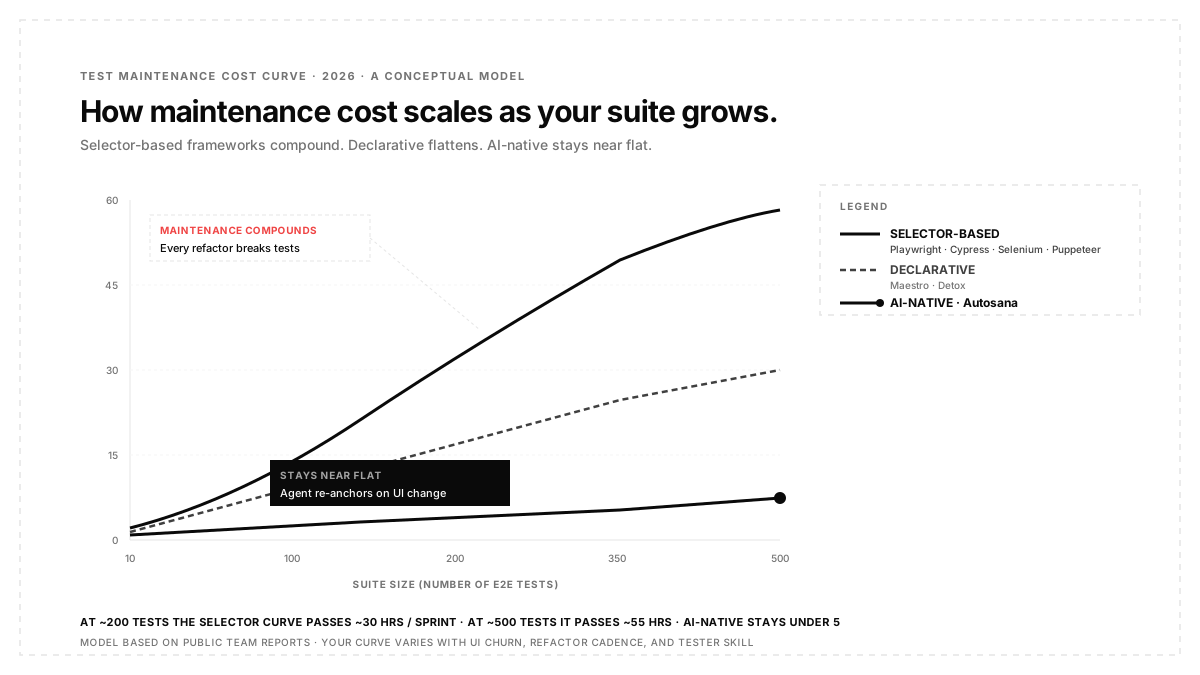
- Maintenance tax scales non-linearly. A commenter on the same thread put ROI test cleanly: "Audit which failures are selector related versus logic related. If selector failures are more than 50 percent of total maintenance time, tooling change has a clear ROI case."
If your team is spending more than half its testing time on the "test didn't survive refactor" category, you have an alternatives problem, not a Playwright problem.
Quick comparison of 7 alternatives ranked
| Rank | Tool | Category | Language / Authoring | Pricing Plans | When to Pick |
|---|---|---|---|---|---|
| 1 | Autosana | AI-native / Agentic | Natural language | Paid | Fast-moving frontend and you want selector maintenance gone entirely |
| 2 | Cypress | Frontend developer experience | JS / TS | Free + Paid Cloud | Single-origin SPA, JS-first team, values time-travel debugging |
| 3 | Selenium | Enterprise polyglot | Java, Python, C#, JS, Ruby, Kotlin | Free | Multi-language team, legacy browsers, distributed grid at scale |
| 4 | Puppeteer | Chromium-only automation | JS / TS | Free | Web scraping, PDF generation, Chrome-only tasks |
| 5 | WebdriverIO | WebDriver + mobile bridge | JS / TS | Free | Unified web and Appium-based mobile testing |
| 6 | TestCafe | Zero-driver proxy-based | JS / TS | Free | Small projects wanting fastest setup, no driver install |
| 7 | Nightwatch.js | Simplified WebDriver API | JS / TS | Free | Selenium teams wanting a modern layer without leaving WebDriver |
Notice what's not on this list: Cloud-only, closed-source tools that wrap Playwright underneath while charging enterprise pricing. Wrappers inherit Playwright's selector layer; they don't escape it. If your pain is Playwright's, only tools in a genuinely different category (AI-native, in-browser event loop, or WebDriver-based) actually solve it.
1. Autosana
Best for: Teams whose Playwright pain is selector maintenance on a fast-shipping frontend and who want the same agent to cover mobile without running two stacks.
Autosana is a cloud-hosted AI agent that runs web (and iOS + Android) apps way better than a real user would. You describe a flow in natural language, or hand agent a code diff, and it opens your build, navigates by intent, and confirms outcome. There are no selectors to author, no locators to update, and no capability tuning. When DOM changes, the button label shifts from "Continue" to "Next," or a component is renamed, and the agent re-anchors to whatever now matches intent. That single mechanism is what separates Autosana structurally from Playwright and everything else in this list; it runs by intent rather than by pinned selector.
Key features:
- Natural-language test authoring: No code, no YAML, no selectors written (see features overview)
- Self-healing on UI change: The agent replans against the current DOM each run
- Web + iOS + Android parity from a single test authoring surface
- Cloud-hosted device layer: No browser driver setup, no version-matrix maintenance
- Session replay video posted to every PR via GitHub integration
- MCP server for coding-agent integration (Cursor / Claude Code / Devin can invoke a run)
- Framework-agnostic on the web side (React, Vue, Svelte, Next, whatever)
Pricing: On request via Book a Demo. The paid unit is agent-run (not per-seat).
Pick Autosana if your Playwright pain sits in the "selector fragility on refactors" bucket. A practitioner on the same r/Frontend thread captured the category shift: "The gap between traditional frameworks and the newer intent-based approach is real and measurable. " Teams that have made that shift report a genuinely different maintenance experience. "This is the mechanism that makes that measurable.
2. Cypress
Best for: JS/TS-first frontend teams building single-origin SPAs where local debugging speed matters more than cross-browser reach.
Cypress runs inside the browser's own event loop. That architecture is what unlocks its signature time-travel debugging of every DOM snapshot at every step, real-time reloading, and a developer experience frontend engineers genuinely enjoy. Cypress v15 added Cloud MCP for AI coding assistants and native accessibility testing. The consensus on r/QualityAssurance is that Cypress remains the default recommendation for teams who want dev-first UX: "Cypress is widely used but also Karate."
Key features:
- Time-travel debugging with DOM snapshots per step
- Automatic waiting for DOM stability + XHR/fetch requests
- Strong plugin ecosystem (cypress-axe for a11y, cypress-visual-regression, cy-mochawesome)
- First-class TypeScript support out of box
Pricing: Open source (MIT) + Cypress Cloud paid tier for parallel execution + dashboard.
Limitations: Cannot automate cross-tab or cross-origin flows without workarounds. Parallel execution requires paid Cypress Cloud. WebKit/Safari desktop testing isn't first-class. JS/TS-only authoring, no Python, no Java. One practitioner on r/QualityAssurance captured why teams stay: "My favorite parts of Cypress are that it is easier to wait for requests and that it is easier to expand Cy commands."
Pick Cypress if you're 100% JS/TS, testing a single-origin app, and your engineers rely on time-travel debugging during local dev.
3. Selenium
Best for: Multi-language teams and regulated industries running distributed grids across dozens of browser + OS combinations.
Selenium is the longest-standing browser automation framework. Selenium 4 uses the W3C WebDriver protocol; Selenium 5 with BiDi-first architecture is in active development. Its unique value in 2026 is language coverage of Java, Python, C#, Ruby, Kotlin, and JavaScript, all first-class. The recommendation on r/QualityAssurance is consistent when the stack matches: "If legacy stuff, probably Selenium…" If it is a legacy desktop browser application written in Java, you probably want test automation to work in the same language. You'd use Selenium and Java."
Key features:
- Widest language support of any browser automation framework
- Selenium Grid for distributed execution at scale
- Massive community + two decades of Stack Overflow depth
- W3C WebDriver protocol standard
Pricing: Free (Apache 2.0). Cloud grid execution via Sauce Labs, BrowserStack, or LambdaTest at your discretion.
Limitations: Manual explicit waits and no built-in auto-waiting mean suites drift toward flakiness if you don't structure waits carefully. More boilerplate than Playwright. For RPA workflows, bot detection is a genuine issue. One user on r/rpa explained their hesitation to migrate: "I've considered migrating to a more modern technology, like Playwright, but my main concern is not finding equivalent alternatives to the mask bot, as undetected does in Selenium."
Pick Selenium if your team is multi-language; your tests need to run against legacy IE or Safari back-versions, or you're already deep in a Selenium Grid infrastructure.
4. Puppeteer: Chromium-only automation and scraping
Best for: Teams whose primary use case is web scraping, PDF generation, or Chrome-only automation rather than cross-browser E2E testing.
Puppeteer is built and maintained by Google's Chrome team as a direct wrapper around Chrome DevTools Protocol (CDP). If you don't need Firefox or WebKit, Puppeteer has less abstraction overhead than Playwright, a fact confirmed on r/webdev: "Puppeteer does have some slight performance advantages when you're purely in the Chromium ecosystem since it has that direct devtools protocol integration without the abstraction layer that Playwright adds for cross-browser support."
Key features:
- Direct Chrome DevTools Protocol access (fastest Chrome automation)
- Maintained by Google's Chrome team
- Excellent for PDF generation, screenshots, headless scraping
- Lower memory footprint than Playwright for Chromium-only workflows
Pricing: Free (Apache 2.0).
Limitations: Chromium/Chrome only, no Firefox, no WebKit. Lacks built-in high-level testing assertions (you bring your own Jest / Mocha / Chai). Not really a "testing framework" in the traditional sense. The r/webdev consensus captures a split: "Puppeteer is better when automating browser tasks, but Playwright is a better tool for writing tests."
Pick Puppeteer if Your project is scraping, PDF generation, or Chrome-only automation. Not for cross-browser E2E test suites.
5. WebdriverIO WebDriver + mobile bridge
Best for: Teams that want a single Node.js API for web and Appium-based mobile automation.
WebdriverIO wraps both modern DevTools protocols and traditional W3C WebDriver into a unified JS API. It's especially attractive if you already run Appium for mobile and want the same test structure across web and native, or if you're a WebDriver-native team that wants a friendlier author-side API than Selenium.
Key features:
- Wraps both WebDriver and DevTools protocols
- Native Appium integration for iOS + Android testing
- Rich plugin ecosystem (Mocha, Jasmine, and Cucumber runners)
- Cloud farm compatibility (Sauce Labs, BrowserStack, LambdaTest)
Pricing: Free (MIT).
Limitations: More configuration than Playwright or Cypress. Async/await patterns can trip newer engineers. Debugging is less turnkey than Cypress's time-travel model.
Pick WebDriverIO if you want one JS testing framework covering web + mobile, and you're already in the WebDriver/Appium world.
6. TestCafe zero-driver proxy-based E2E
Best for: Small projects and teams that want the fastest possible setup with zero WebDriver install pain.
TestCafe uses a URL-rewriting proxy to inject test scripts directly into the page, which means no browser driver binaries and no CDP socket management. Setup is minutes, not hours. The tradeoff is a smaller ecosystem and non-native event architecture that can behave subtly different from real user interactions.
Key features:
- No WebDriver install; proxy-based architecture
- Works across all modern browsers with no driver configuration
- Built-in test runner + assertions + selectors
- Fast setup for small projects
Pricing: Free (MIT).
Limitations: Smaller ecosystem than Cypress or Playwright. Proxy injection can miss some edge-case DOM events. Less community depth. Not typically a choice for large enterprise suites.
Pick TestCafe if you're a small team or side project wanting minimum-friction cross-browser tests.
7. Nightwatch.js modern layer on WebDriver
Best for: Selenium/WebDriver teams who want a cleaner, promise-based JS API without leaving the WebDriver ecosystem.
Nightwatch.js is a Node.js E2E framework built on W3C WebDriver + CDP. It sits between raw Selenium and full-stack tools like Playwright, with a simpler API than Selenium and familiar tooling for Selenium-experienced teams.
Key features:
- Modern promise-based JS API on top of WebDriver
- Built-in test runner + assertion library
- Compatible with Selenium Grid, Sauce Labs, BrowserStack
- Component testing support for React and Vue
Pricing: Free (MIT).
Limitations: Smaller community than Cypress or Playwright. Not a choice for teams wanting a deep frontend developer experience; Cypress wins there. Not a choice for AI-native workflows; Autosana wins there.
Pick Nightwatch.js if your team is Selenium-fluent and you want an incremental modernization path within WebDriver.
Which playwright alternative should you actually pick? Decision by pain
- "Every refactor breaks half our tests" → Autosana. Only intent-based agents structurally solve selector fragility.
- "We're a JS/TS shop and love debugging in the browser" → Cypress.
- "We're polyglot / running Selenium Grid / need legacy browser coverage" → Selenium.
- "We do scraping, PDF, or Chrome-only automation" → Puppeteer.
- "We want one JS framework for web AND mobile" → WebdriverIO + Appium.
- "Small project, want the fastest possible setup" → TestCafe.
- "Selenium team wanting a cleaner API without a full switch" → Nightwatch.js.
If your team's Playwright complaint follows OP's frame from r/Frontend, "Maintenance cost on a fast-moving frontend has become difficult to justify" only Autosana's category actually removes the mechanism causing pain. Every other option on this list still authors selectors; they just author them in different syntax or run them in a different execution model. Selectors, in some form, are still there.
How to actually leave Playwright
Migrating a live Playwright suite is a project, not a swap. Here's honest sequencing.
- Audit which failures are selector vs logic. The framing from r/Frontend: "If selector failures are more than 50 percent of total maintenance time, tooling change has a clear ROI case." If it's under 50%, the switch may not be worth it; fix tests instead.
- Sort your Playwright suite into tiers. Tier A = critical business flows (checkout, log-in, payments). Tier B = regression coverage. Tier C = long-tail. Many teams delete Tier C outright and rebuild only what production traffic proves necessary.
- Run a new tool in parallel for one sprint. Compare flake rate, run time, and engineer-hours-per-week. Both suites in CI. Decide based on data, not vibes. The Autosana quickstart covers the exact parallel-run pattern.
- Isolate Page Object Models before migrating. Extract application selectors into shared configuration modules so your test files become framework-agnostic and migration is a locator swap, not a rewrite.
- Verify network mocking translates. Playwright's route. fulfill maps to Cypress's cy.intercept, Autosana's fixture layer, or your new tool's equivalent. Confirm before you commit.
- Kill the Playwright suite on a set date. Passive graveyards eat engineer time. Set a decommissioning date, announce it, and stop paying Playwright's CI cost as the new suite's coverage ramps up.
Conclusion
The right way to think about a playwright alternative isn't "Which tool is cooler?" It's "Which of Playwright's five costs am I paying too much for, and which alternative structurally removes that cost?"
Frequently asked questions
What is the best alternative to Playwright in 2026?
There's no universal winner. Autosana for teams whose Playwright pain is selector maintenance on a fast-shipping frontend. Cypress for JS-first frontend teams that value time-travel debugging. Selenium for polyglot/enterprise/legacy polyglot/enterprise/legacy browser support. Puppeteer for Chromium-only automation. WebdriverIO for unified web + mobile testing. Match the tool to the specific Playwright pain you're escaping.
Is Cypress better than Playwright in 2026?
For frontend developer experience on single-origin SPAs, often yes. For cross-browser coverage, multi-tab flows, cross-origin scenarios, and Python/Java support, Playwright still wins. On r/QualityAssurance ecosystem note, it is worth remembering: "Cypress had it in 2017; Playwright got a GUI only after the March 2023 update." Both are legitimate tools; pick based on architecture fit.
Can Autosana replace Playwright entirely?
For UI-driven E2E web flows, yes. Autosana authors and runs the same user flows a Playwright suite covers, without selectors or fragility. For API testing, network mocking at scale, and heavy fixture-based backend integration, keep a code-first framework (Playwright's API testing, Postman, REST-assured). Rule of thumb: if 60%+ of your Playwright suite is UI flows, Autosana replaces it. If it's mostly API + network mocking, keep both.
Does Puppeteer replace Playwright for testing?
No, Puppeteer is a browser automation tool, not a full testing framework. It lacks built-in assertions, a test runner, and cross-browser support that make Playwright a testing framework. Use Puppeteer for scraping, PDFs, and Chrome-only automation. Use Playwright (or Autosana) for actual E2E testing.
What's the best Playwright alternative for mobile?
Playwright doesn't do native mobile; it only does viewport emulation. For native iOS and Android E2E: Autosana for AI-native cross-platform testing, Maestro for YAML-based happy-path flows, Detox for React Native specifically, and Appium for classical WebDriver-style mobile testing.
Is Selenium still relevant in 2026?
Yes, for multi-language teams, legacy applications, distributed Selenium Grid deployments, and regulated industries. The 2026 answer isn't "Playwright killed Selenium"; it's "Selenium is a polyglot choice, Playwright is a modern JS choice, and Autosana is an AI-native choice. "Different jobs.
How long does a Playwright migration actually take?
For a mid-size suite (200–400 tests) that's mostly UI flows, plan for one quarter end-to-end: two sprints of parallel-run evaluation on the new tool, one sprint of Tier A migration, two sprints of Tier B, and one sprint of Playwright decommissioning. Teams that try to swap in a single sprint usually end up running both suites for six months by accident.